Treatment notes
What I have seen work, what I lean toward, and how to avoid hurting yourself.
These are notes from my own experience and from the many aquarists who have written to me, not controlled experiments. My thinking has changed over the years, and it may change again. Check the current reef-keeping literature as well.
Read this too: the Dinoflagellate Guide is a thorough, practical guide to dealing with dino blooms that was written by another aquarist. It is more detailed than my notes, and we differ in a few places (see the guides page). Prefer to watch? See the practical walkthrough video.
Safety first
Some of these organisms are toxic, and the biggest risk is often when large numbers die off at once. Ostreopsis is the most dangerous, and even Amphidinium, which is only mildly toxic in the literature, has caused problems for aquarists. People have reported symptoms such as respiratory irritation and nausea while treating tanks.
- Identify it first. Know what you are dealing with.
- Remove as much as you can by hand, first, and secure the removed material so kids and pets cannot get to it.
- Ventilate the room, and run fresh activated carbon on the tank, particularly if a lot of cells are dying.
- Keep pets and children away from the aquarium.
- If you feel unwell near the tank, get out of the room and into fresh air, and seek medical advice if symptoms continue.
Which toxin?
| Dinoflagellate | Toxin | Known for |
|---|---|---|
| Ostreopsis | Palytoxin | The same toxin as Palythoa corals |
| Gambierdiscus | Ciguatoxins | Ciguatera |
| Amphidinium | Amphidinols | They break down very rapidly |
| Prorocentrum | Okadaic acid | Diarrhetic shellfish poisoning. The Prorocentrum in home aquaria are not thought to make it, but that is hard to prove. |
| Coolia | Varies by species (one is called cooliatoxin) | Toxic, but little is known. Hard to identify with a home microscope. |
| Alexandrium | Saxitoxins | Paralytic shellfish poisoning |
Think ecology first
Most of what I recommend now is about the tank as a community, not about killing dinos.
What I have noticed
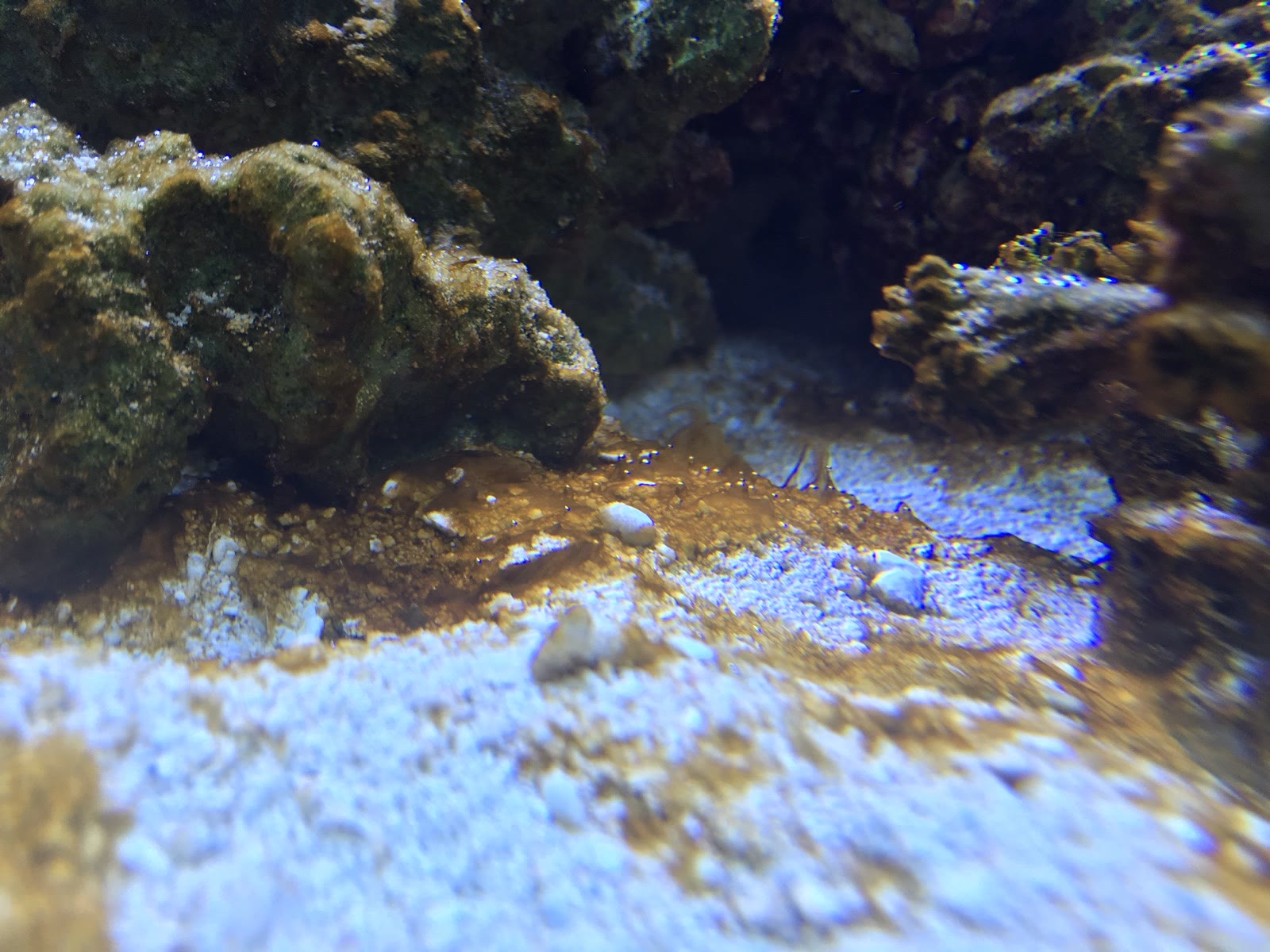
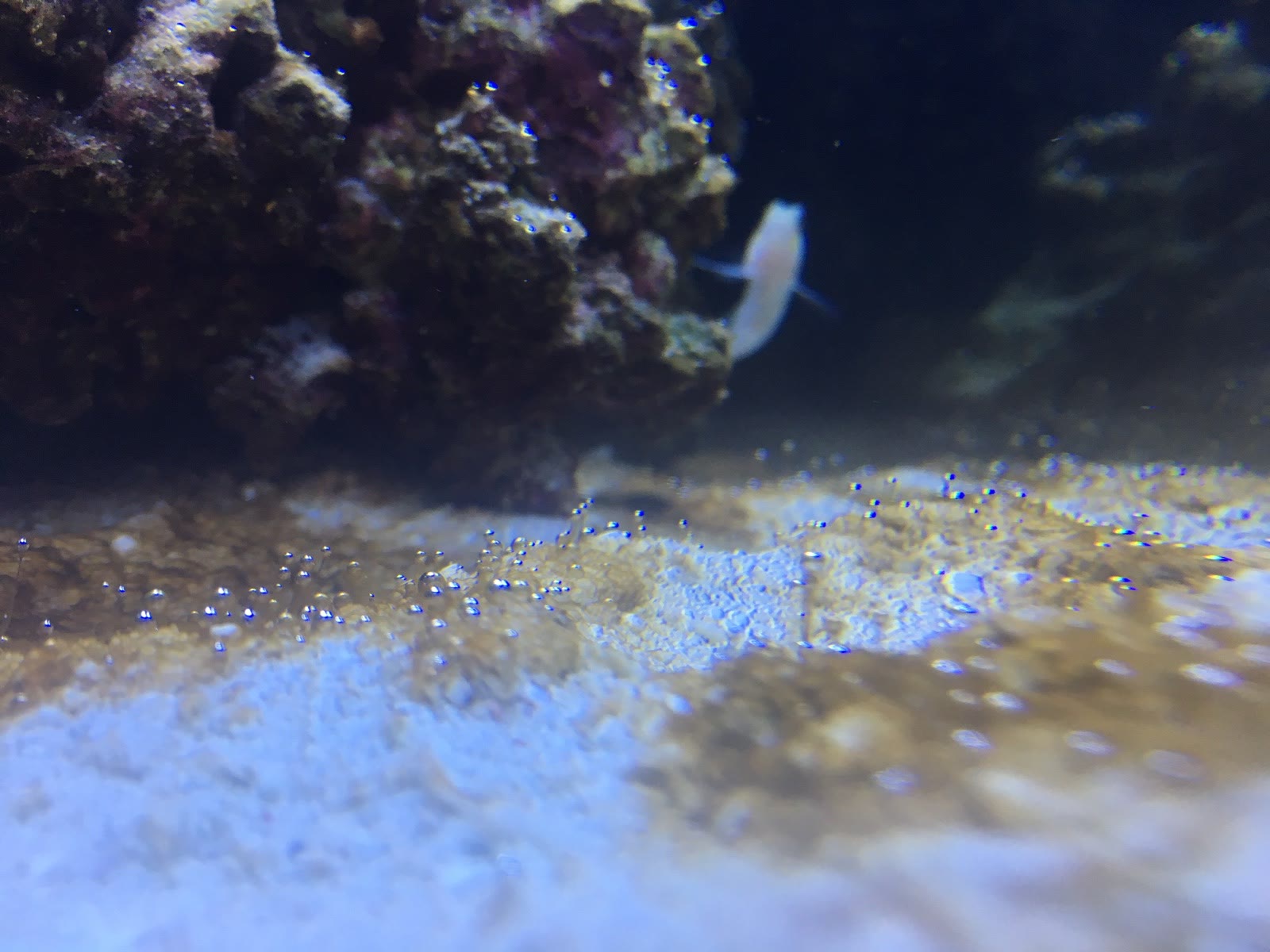
The people who wrote to me with the worst, most persistent outbreaks very often had extremely low nutrients, frequently too low to measure. I first wondered whether it was only people with elaborate, expensive setups who sought me out. But the pattern held up as I collected more information, and I now think it is real. I also noticed that aquarists who fought cyanobacteria by driving their nutrients to zero often ended up with dinos next.
Why I think it happens
- Competition. In culture, dinos do well in rich media but grow slowly compared with most other algae. When nutrients are available, faster-growing algae win. When nutrients are almost gone, dinos are among the few algae that can still grow.
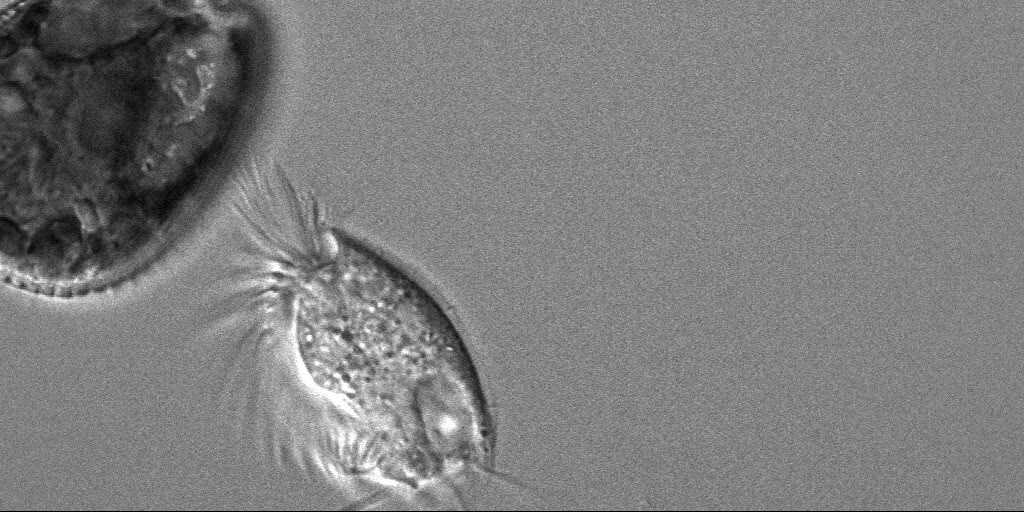
- Missing grazers. A very sterile setup may have lost, or may never have had, the small animals and ciliates that graze on dinos. See ciliates.
- They are usually already there. When I look at sand from healthy reef tanks under a microscope, I can usually find a few dinos. They cause no trouble and you cannot see them without a microscope. A bloom, which you can see, happens when conditions let one take over.
What I suggest
- Seed your tank with sand from a healthy, established aquarium. This is what I recommended most often in emails and forum posts. It brings in a mix of grazers, ciliates, and other microlife. Rubble and debris from a mature system work too.
- If your nutrients are at or near zero, consider bringing them up slowly. For years I was hesitant to suggest this, because people had worked hard to get their nutrients that low. But it makes sense in light of the competition idea, and the Dinoflagellate Guide recommends it too. Change things gradually and test as you go.
- Reduce high nutrients if you need to, but not to zero, when fighting another algae such as cyanobacteria. See the cyano section.
- Be careful with very aggressive protein skimming. This is a hunch, not something I have tested: an aggressive skimmer might be removing the predators you want.
Physical removal
Taking out as many cells as you can is almost always worthwhile, and it is low risk if you follow the safety notes.
- Siphon and wipe. Remove all the visible film and strings by hand. If cyanobacteria are mixed in, remove those too.
- A filter sock catches a lot of what you stir up. Rinse it often so that it does not clog.
- More flow. Blasting surfaces with a powerhead dislodges cells, which you can then filter out.
- A "dino scrubber". Hang rough netting or filter floss in strong flow under good light, then rinse it out in freshwater a few times a day. It collects a lot of cells, especially Ostreopsis. It is a fancier version of hand removal, and a handy one. (This trick comes from another aquarist. The Dinoflagellate Guide describes it with pictures.)
- A UV sterilizer can be run only during lights-out. Be aware that it kills ciliates, which may be eating the dinos, too.
- A light trap at night could help collect cells that swim up into the water.
Chemical treatments and blackouts
I have always been uncomfortable with peroxide and other chemical treatments. In my older notes I listed peroxide dosing and long blackouts as the steps that "seem necessary", based on what aquarists were reporting at the time. I no longer think that is a good summary.
- Many people report that peroxide, or long blackouts, knocked a bloom back, but also that it came back. Long blackouts stress corals and anemones. A blackout can reduce Amphidinium, but it will not get rid of it permanently.
- The Dinoflagellate Guide advises against peroxide and other chemical treatments, on the grounds that they reduce biodiversity and can let a bloom return stronger.
- Some commercial products are popular for dinoflagellates. I do not know what is in some of them. A forum post said one popular product was the antibiotic cycloheximide, which blocks protein synthesis in eukaryotic cells and is used as a fungicide and in laboratory work. I do not know whether that is true. Many of the steps those products require, like a long dark period and removing filtration, are themselves treatments for dinos, so it is worth trying all of those steps without the product first.
- Peroxide and similar chemicals can harm corals, anemones, and the small organisms you are trying to rebuild, and they do not fix the underlying cause. They also do not fit with the ecological approach above. I would try everything else first. If you do use one, ventilate the room and run carbon, as in the safety notes. I do not give doses here.
I have also read that raising pH helps. I am skeptical, but I do not think it will hurt.
Other things to know
Algae turf scrubbers
A scrubber needs a large surface area to work, so make it as big as you have space for. If you dose peroxide, remove the scrubber first, since it will not like it.
Salinity shocks
Dinoflagellates are easily lysed by a sudden change in salinity of even 10 ppt. Most corals and fish tolerate a short freshwater dip, but some cannot. A dip is a good idea for new corals before they go in the tank, not for treating the tank itself.
Dosing silicate
Many aquarists now use and recommend dosing silicate to start a diatom bloom that outcompetes the dinos. It is something I suggested to an aquarist back in 2016. It needs care and monitoring, so see the diatoms section before you try it.
Preventing a repeat
- Seed new tanks with sand and rock from established ones, or with sand from a healthy system.
- Keep some measurable nutrients and let something grow somewhere in the system. A tank with no algae growth anywhere is not necessarily a healthy one.
- Make changes gradually. Dinos adapt quickly, and the rest of the community does not.
- Do not use nutrient-stripping tools on a new tank.